
International Media Center | Science & Space
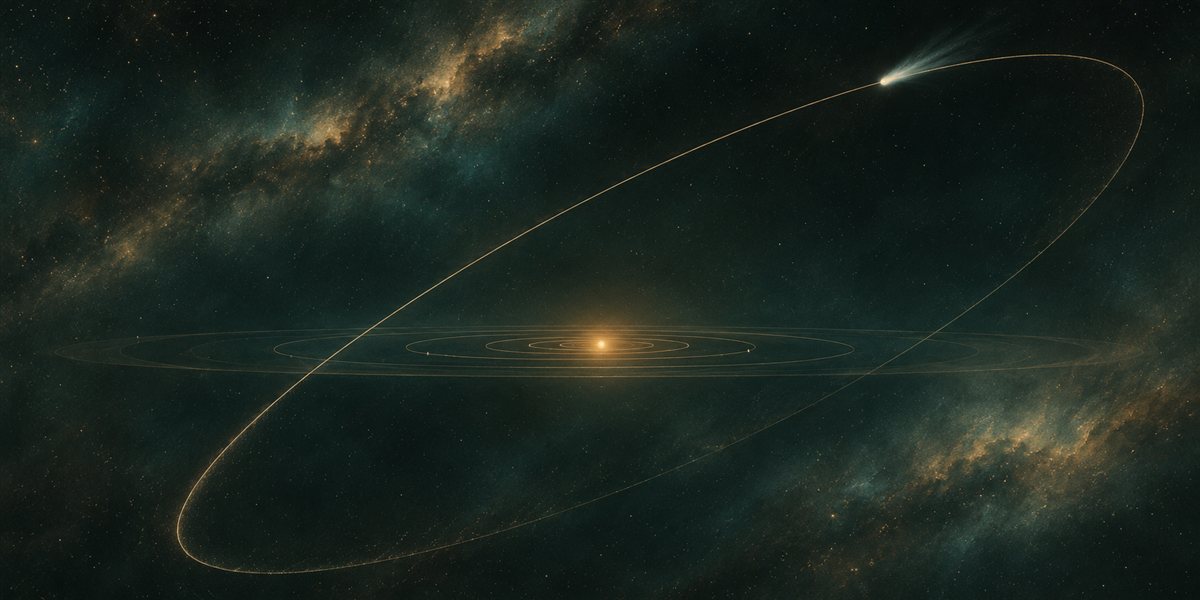
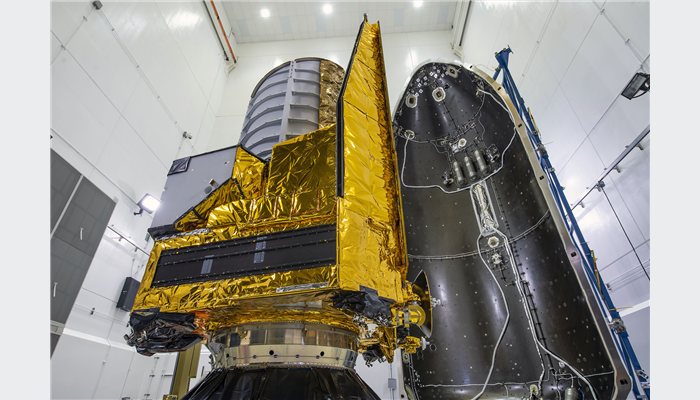
In a new scientific discovery, the European Space Agency’s (ESA) Euclid space telescope has identified its first previously unknown comet during its mission to study distant galaxies and the large-scale structure of the universe. Designated C/2026 S1 (Euclid), the comet was approximately 1.3 billion kilometres from Earth when its discovery was announced. Initial calculations suggest that it takes thousands of years to complete one orbit around the Sun.
An Unexpected Discovery Among Images of Distant Galaxies
The discovery began while Euclid was capturing images of a region of the sky known as the North Deep Field, as part of a scientific programme designed to study distant galaxies. During the analysis of the images, researchers noticed a faint streak of light appearing in several exposures, suggesting the presence of a moving object against the background of stars and galaxies.
The images were captured between 16 and 24 September 2026. Mikko Pöntinen, a doctoral researcher at the University of Helsinki, identified the streak using specialised software he had developed to detect moving objects in Euclid’s images. By tracking its position, he was able to identify the object across five groups of images, comprising a total of 16 exposures.
Further examination revealed a faint cloud of gas and dust surrounding the object, known as a cometary coma, one of the characteristic signs of cometary activity.
After confirming that the object did not match any previously catalogued comets or asteroids, the observations were submitted to the Minor Planet Center of the International Astronomical Union. Ground-based observatories subsequently contributed additional observations to track its movement. On 8 October 2026, the centre confirmed its classification as a newly discovered comet under the designation C/2026 S1 (Euclid).
A Comet Following an Orbit That Takes Thousands of Years
According to the European Space Agency, the comet was approximately 1.3 billion kilometres from Earth when its discovery was announced on 19 October 2026. This distance is roughly comparable to the distance between the Sun and a region of space located between the orbits of Jupiter and Saturn.
The comet follows a highly inclined orbit compared with the plane in which most planets in the Solar System revolve around the Sun. This unusual orbital orientation makes it particularly interesting from an astronomical perspective.
Preliminary estimates indicate that the comet takes thousands of years to complete a single orbit around the Sun before returning to the inner Solar System. Further observations are expected to help astronomers refine its orbital calculations and determine its trajectory more accurately.
From Studying Distant Galaxies to Detecting Comets
The significance of this discovery lies partly in the fact that it was made by a space telescope that was not originally designed to search for comets, but rather to study distant galaxies and map the large-scale structure of the universe.
Euclid is designed to examine the distribution, shapes and evolution of galaxies, helping scientists investigate the influence of dark matter and dark energy on the structure and expansion of the universe. Its planned scientific mission extends over approximately six years and involves observing billions of galaxies.
This discovery demonstrates that data collected by telescopes designed to explore the distant universe can also reveal valuable information about objects within our own Solar System, even when those objects are not the primary targets of observation.
Preparing the Way for a Future Comet Interception Mission
The discovery of C/2026 S1 (Euclid) also provides valuable experience for the European Space Agency’s future Comet Interceptor mission, which is designed to intercept and closely study a suitable comet.
Although the newly discovered comet is not considered a suitable target for this mission, the methods used to detect it, identify its nature and coordinate observations between space-based and ground-based teams provide a practical model that could support future searches for scientifically suitable targets.
Ultimately, Euclid’s achievement goes beyond the discovery of a previously unknown comet. It highlights the potential of space telescopes to contribute to multiple areas of astronomical research and demonstrates how exploring the universe can lead to unexpected discoveries, even beyond the original objectives of a mission.
International Media Center | I.M.C
Sources
- European Space Agency (ESA) — Official announcement of the discovery of comet C/2026 S1 (Euclid)
- Euclid Consortium — How researchers discovered the comet and determined its orbit
- California Institute of Technology (Caltech) — Images of the comet and how they were captured