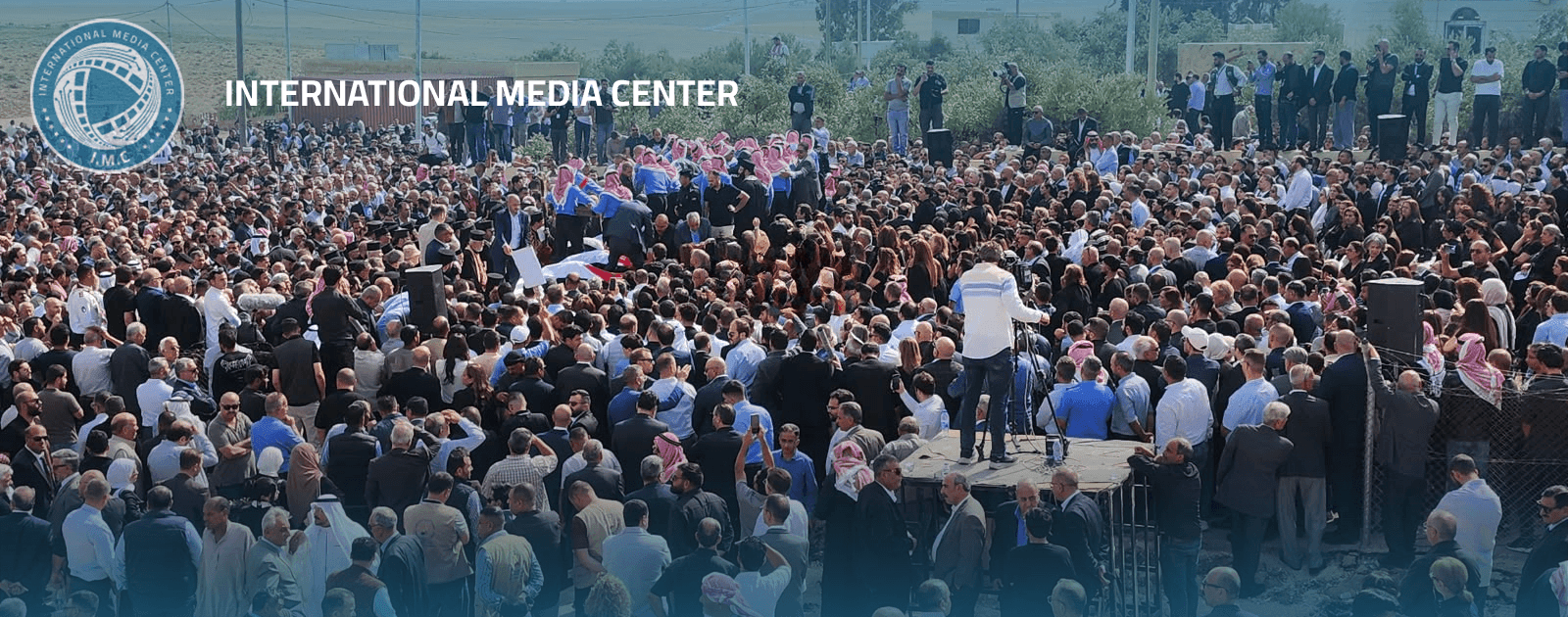
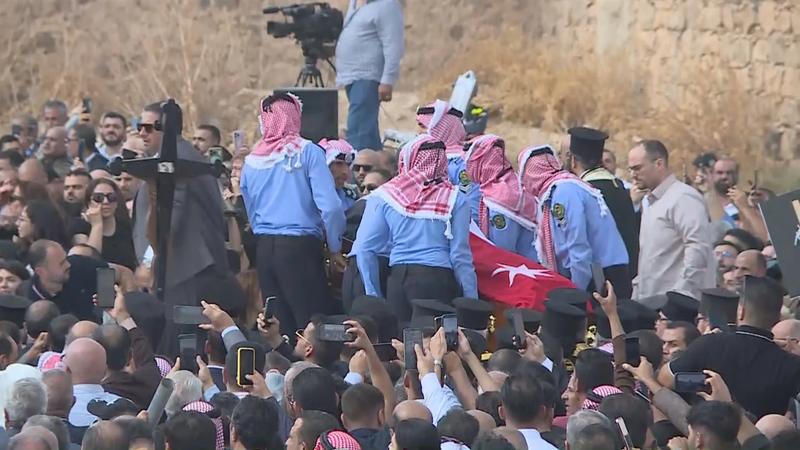

Thousands attend the funerals of victims of the attack on St. George’s Greek Orthodox Church in Hamoud village, amid calls for national unity, the protection of places of worship, and the rejection of extremism.
Karak, Jordan | October 25, 2026
International Media Center (I.M.C.)
By Mona Khalil
Thousands of Jordanians gathered in Karak Governorate on Sunday to mourn the victims of the armed attack on St. George’s Greek Orthodox Church in the village of Hamoud. The tragedy has shocked communities across the country and renewed concerns over extremist violence targeting civilians and places of worship.
Government officials, religious representatives, community leaders, and residents attended the funeral ceremonies in an atmosphere of profound grief and national solidarity. Public Security personnel carried the coffins, draped in Jordanian flags, in a solemn procession reflecting the magnitude of the tragedy and the community’s collective loss.
According to Jordanian official statements and local media reports, the death toll rose to nine, with dozens of others sustaining injuries. Al Mamlaka TV reported that eight victims were laid to rest during Sunday’s funeral ceremonies.
Attack During a Funeral Service
The incident occurred on Friday, October 23, 2026, when gunfire erupted at St. George’s Church in Hamoud village during a funeral service, killing and injuring several people.
Jordanian authorities described the incident as a terrorist attack and confirmed that security agencies were continuing their efforts to pursue those responsible and bring them to justice.
The attack prompted condemnation both domestically and internationally, particularly because it targeted a place of worship during a funeral gathering, raising serious concerns about civilian safety and the sanctity of religious institutions.
A United Farewell and a Memorial for the Victims
The funeral ceremonies drew mourners from Karak and other parts of Jordan, with processions proceeding to a designated burial site opposite the targeted church.
Arrangements included a collective burial site and a memorial dedicated to preserving the victims’ memory, alongside a shared condolence gathering to receive mourners from across the Kingdom.
Beyond the funeral proceedings, these arrangements reflected the determination of the victims’ families and the wider community to confront the tragedy through solidarity and mutual support.
Official Response and National Mourning
At the national level, the Jordanian government declared three days of official mourning beginning Friday, October 23, with flags lowered to half-mast at government institutions and public buildings.
Prime Minister Jafar Hassan affirmed that state security agencies were working to apprehend those responsible for the attack and bring them to justice. He also emphasized the need to confront extremism and the ideological foundations of violence that threaten public safety and social stability.
Jordan’s leadership continued to monitor the security and humanitarian developments surrounding the attack, reiterating its commitment to protecting citizens and preserving national unity.
Religious Condemnation and Calls to Protect Places of Worship
The attack also drew condemnation from international religious institutions.
The Greek Orthodox Patriarchate of Jerusalem denounced the violence and expressed solidarity with the victims’ families and the Jordanian people.
The World Council of Churches likewise condemned the attack, emphasizing the importance of protecting all places of worship, including churches and mosques, and ensuring that people can practice their faith safely and without fear.
These responses underscored the fundamental importance of freedom of religion or belief, the protection of civilians, and the rejection of violence and discrimination regardless of religious affiliation or social background.
Karak and the Challenge of Community Resilience
The consequences of the attack extend beyond the immediate loss of life and physical injuries. Such acts of violence can leave lasting psychological and social effects on bereaved families and local communities.
In this context, providing appropriate medical care for the injured, psychological and social support for affected families, and ensuring effective investigations and accountability under the law remain essential priorities.
Protecting religious institutions, countering hate speech, and preventing incitement to violence are equally important in reducing the risk of further attacks and safeguarding peaceful coexistence.
As Karak bids farewell to the victims, the broader responsibility remains clear: protecting civilian lives, upholding justice, and preserving the values of coexistence that acts of violence and extremism must never be allowed to undermine.
Sources and References
- Jordan News Agency (Petra) | October 25, 2026
Official, Popular Funeral Ceremonies Set for Victims of Karak Terrorist Attack. - Jordan News Agency (Petra) | October 23, 2026
Jordan Declares Three-Day National Mourning for Karak Church Attack Victims. - Jordan News Agency (Petra) | October 23, 2026
Public Security Directorate Warns Against Circulating Unverified Information on Karak Shooting Incident. - World Council of Churches (WCC) | October 23, 2026
Greek Orthodox Patriarchate of Jerusalem and WCC Condemn Attack on Church in Jordan. - Associated Press (AP) | October 23, 2026
Gunmen Open Fire at a Church During a Funeral in Jordan, Killing Seven and Wounding 40. - Reuters | October 25, 2026
Jordan Church Attack Survivor Says Her Cousin Died Before Her Eyes.